OpenAI only needs a dollar! ChatGPT corporate squeezing U.S. government AI’s hegemony.
OpenAI issued a statement announcing a new partnership with the United States General Services Administration. Starting next year, ChatGPT Enterprise will be available to all employees of the federal administration, mostly free of charge. The United States federal agencies involved in the scheme will be able to use its leading front-line model through ChatGPT Enterprise, each paying only a symbolic fee of $1 next year.
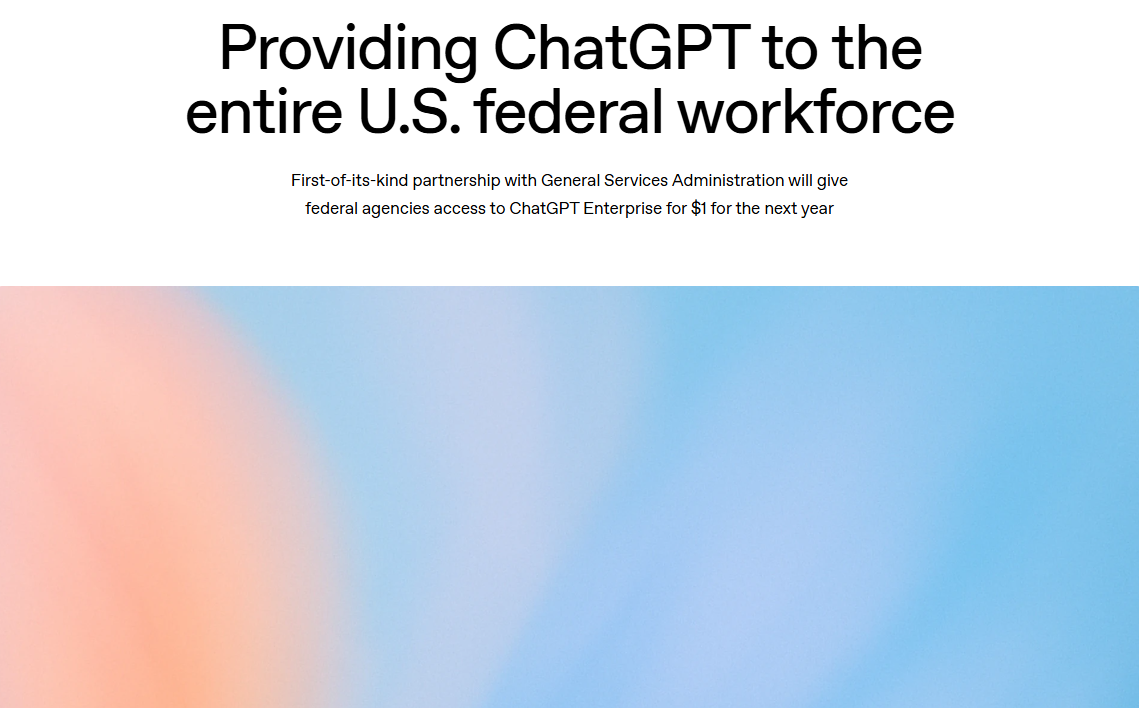
According to the bulletin issued by OpenAI, United States federal government staff will have access to GPS-4 and the new model for the next 12 months at a nominal cost of only $1. During an additional 60 days, OpenAI will provide unrestricted access to advanced models and functions, such as in-depth studies and advanced voice models.
In order to help federal civil servants use AI, OpenAI has established a dedicated government user community and provided customized induction training platforms and guidance through OpenAI Academy to help employees explore and use artificial intelligence. In addition, to help federal agencies take full advantage of ChatGPT, Openai is working with experienced partners Slalom and the Boston Consulting Group to support safe and responsible deployment and training.
In its statement, OpenAI stressed that its goal was to ensure that agencies could use AI safely and responsibly. ChatGPT Enterprise no longer uses business data (including input or output) to train or improve the OpenAI model. The same safeguards will apply to the Federal Government.
The project, “OpenAI for Government”, was set up in June. At the time, the United States Department of Defense had just awarded it $200 million in contracts to develop military AI systems, and now the $1 contract is more like a key to opening the political market.
The Chief Operator of OpenAI, Brad Lightcap, stated that “revenue feedback from government work scenes” would be collected during the pilot. This means that valuable information generated by the federal agencies in the course of the experiment, such as workstream data, a hint template, approval rules, etc., will be the feeder of the training-specific model.
In this move, which coincides with the full implementation of the EU Artificial Intelligence Act and the acceleration of AI legislation by the United States Congress, OpenAI is substantially involved in the design of the national AI governance framework by actively penetrating the system of government. When the civil servants are deeply tied to ChatGPT, regulatory policy development is bound to be influenced.
The current AWS government cloud bill is over $300 million and Microsoft 365 government editions cost $22/user/month. When OpenAI tore the price line at $1, future renewals would have a crushing advantage, even if the price increased to 1/10 in the commercial version ($20/user/month). More crucial is the fact that the costs of moving government systems will form a natural moat.
Indeed, there is a long-standing precedent for subsidies by technology companies: Microsoft sold cloud services to the Ministry of Defence at 0.5 per cent in 2014, eventually taking down a billion-degree JEDI contract; and the Amazon offered a drug review AI free of charge to the FDA in 2021, the following year being qualified as an exclusive supplier for medical supervision. OpenAI’s aggressive strategy, however, is still on record: the US$ 1 contract covers 85 federal agencies and 4 million civil servants, reaching unprecedented levels.
Despite the US Department of Justice’s claim of a “zero data retention” model, Stanford legal experts point to a fatal loophole: When civil servants use ChatGPT to draft policy documents and analyse classified data, even if the original content is not stored, the model may absorb sensitive information features by fine-tuning weights. Even more alarming — OpenAI has yet to disclose to the United States Congress the sources of training data and auditing mechanisms for the federal model.
The free-opening of doors often requires the most expensive key to unlock — perhaps the best footnote to the AI-era political relationship.

Related Posts
Meta introduces the “business agent” function: AIS provides services in WhatsApp and Instagram

From games, content creation to business decision-making, the A generation reshaped the Indian consumer economy